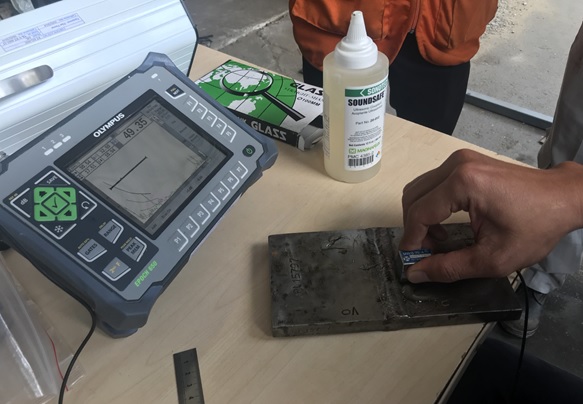
Ultrasonic testing (UT) is a nondestructive method in which beams of sound waves at a frequency too high to hear are introduced into materials for the detection of surface and subsurface discontinuities in the material. These acoustic waves travel through the material with some attendant loss of energy (attenuation) and are reflected at interfaces. The reflected beam is displayed (or reduces the display of transmitted sound) and is then analyzed to define the presence and locations of discontinuities or discontinuities. Applications. Ultrasonic testing of metals is widely used, principally for the detection of discontinuities. This method can be used to detect internal discontinuities in most engineering metals and alloys. Bonds produced by welding, brazing, soldering and adhesive bonding can also be ultrasonically examined. Inline techniques have been developed for monitoring and classifying materials as acceptable, salvageable or scrap and for process control. Other applications include testing of piping and pressure vessels, nuclear systems, motor vehicles, machinery, structures, railroad rolling stock and bridges and thickness measurement.
Acceptance criteria standard.
Structural Welding: AWS D1.1
Power Piping Welding: ASME B31.1
Piping process Welding: ASME B31.3
Pressure Vessel Welding: ASME Section VIII Div 1, Div 2
ISO 5817: Welding — Fusion-welded joints in steel, nickel, titanium and their alloys (beam welding excluded) —Quality levels for imperfections.
ISO 11666, Non-destructive testing of welds — Ultrasonic testing of welded joints — Acceptance levels
 AITECH JOINT STOCK COMPANY


