The Similarities Between Ultrasonic Thickness Gauges and Flaw Detectors
Ultrasonic thickness gauges and flaw detectors use the same basic concepts. They both use transducers that generate sound waves and both measure the time it takes for that sound to leave a transducer, travel through a material, bounce off a reflector, and return to the transducer.
A sound pulse generated by a transducer travels through a test piece and reflects back from the inside surface or far wall
And both use the basic equation of:
Distance = (Velocity x time) / 2
This equation divides by two since the one-way time measurement to the reflector is all that’s required.
The reflection and transmission of high-frequency sound waves—known as ultrasound—has long been an important tool for evaluating the integrity of welds, as well as testing structural metals, pipes and tanks, boiler tubes, railroad rails and axles, aerospace composites, and many other industrial applications.
Industrial ultrasonic testing equipment continues to be popular since it:
Selecting an ultrasonic thickness gauge or flaw detector for an application largely depends on the main goal of the measurement. Before we get into the key differences between these instruments, let’s take a brief look at their use throughout the years.
Here are some advantages of an Olympus ultrasonic thickness gauge:
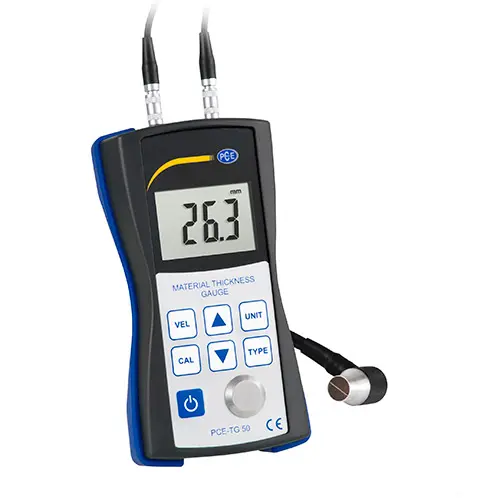
Advantages of an Ultrasonic Flaw Detector
Here are some advantages of an Olympus ultrasonic flaw detector:
Highly versatile:
Straight beam inspection measures to a defect or a void to locate the distance to the flaw from the material’s surface.
Angle beam inspection to check the integrity of welds.
Ideal for scanning applications (due to a faster update rate of 60 Hz compared to a 25–30 Hz update rate of a thickness gauge)
Includes specialized software for sizing defects:
Distance amplitude correction (DAC)
Time varied gain (TVG)
Distance gain sizing (DGS)
 AITECH JOINT STOCK COMPANY
THE RELIABILITY OF NON-DESTRUCTIVE TESTING
Headquarter:119/27 Bui Quang La Street, An Hoi Tay Ward, Ho Chi Minh city.
Brach: No. 23, Street 27, Van Phuc Residential, Hiep Binh Ward , Ho Chi Minh City
Phone: (+84) 908 886 827, 0981398185
Email:maianhtai@ndt.com.vn


